AI agents are no longer a pilot project in network operations. In a recent Omdia study of 1,000 IT and network operations leaders, commissioned by Cisco, 51% said they already run agentic AI that acts in production. 82% said they’re comfortable letting AI make at least some production network changes without prior human approval.
Every major network and security vendor now has an agentic story. The details differ, but the loop looks familiar: understand the intent, propose a change, validate it, deploy it, and record what happened. That validation step is the one security teams ask about most, and it’s the right thing to ask about. It’s also where most of these loops quietly come up short.
Validation only covers what the tool can see
When a vendor says its agent validates a change before deploying it, the check is real. The agent looks at the rule it’s about to push, compares it against the policy on that platform, flags conflicts, and often asks for approval on high-impact changes.
The catch is scope. An agent built into one vendor’s management console validates against that vendor’s devices, that vendor’s objects, and that vendor’s view of the network. It can confirm the new rule is clean on its own firewall. It can’t tell you whether the traffic will actually make it from source to destination, because the path almost never stays on one vendor’s gear.
That isn’t a flaw in any single product. It’s a structural limit. Each vendor optimizes the loop it controls. Nobody’s loop was designed to check the firewall in the next hop, the cloud security group behind it, or the segmentation policy on the destination workload.
The Omdia study points at the same gap. 69% of respondents said they require detailed explainability for agent-driven actions. Teams want to trust what agents do, and that starts with seeing why they did it.
What a real change looks like
Take an ordinary request: a new application in AWS needs to reach a database in an on-prem data center, and remote users need to reach the application through SASE.
On paper, that’s one connectivity request. In practice, the path might cross:
- An AWS security group and network ACL
- A cloud firewall at the VPC edge
- A perimeter firewall from one vendor at the data center
- An internal segmentation firewall from a second vendor
- A microsegmentation policy on the database host
- A SASE access policy for the remote users
That’s six enforcement points across at least four policy systems. Each one might have its own agent, each agent might validate perfectly, and the application can still fail on day one because no one checked the full path. Or worse, it works, because one of those agents opened something far broader than the request needed, and nobody saw it in context.
The second outcome is the one that should worry security teams. A change that breaks connectivity gets noticed within the hour. A change that quietly widens access across a zone boundary can sit there for months, until an attacker finds it. From there, that extra access becomes the path for lateral movement, from the first compromised system to the ones that matter.
What end-to-end validation actually requires
Validating a change across the whole network takes more than a better agent. It takes a layer that sits above every vendor and answers four questions before anything is pushed.
- Will the traffic actually flow? That means modeling the full path across on-prem firewalls, cloud controls, SASE, and microsegmentation, not just the device being changed.
- Is it the least access that does the job? Each hop should open only what the request needs, so one broad rule doesn’t undo the precision of the others.
- Does it break policy? The change should be checked against your zone-to-zone segmentation rules and against frameworks such as PCI DSS, NIST, and ISO 27001, before it reaches production.
- Can you prove what happened? Every step, from request to approval to the rule on each device, needs to be recorded in one place an auditor can follow.
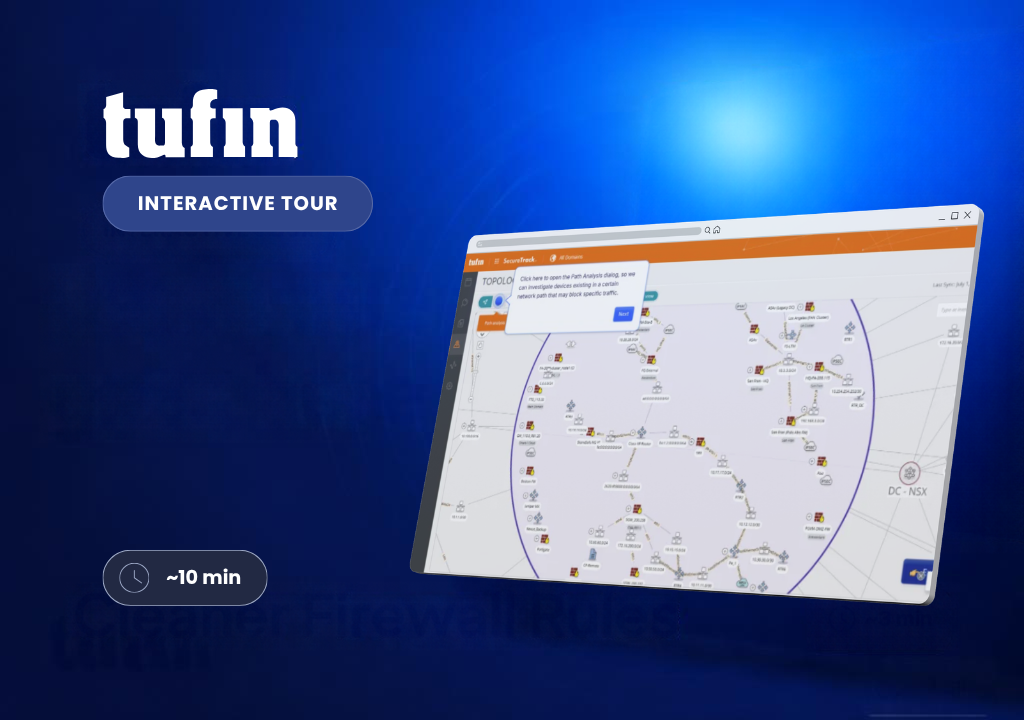
This is the job Tufin was built for. Tufin Orchestration Suite maintains a live model of connectivity across firewalls, routers, clouds, SASE, and microsegmentation from multiple vendors. When a change is requested, Tufin analyzes the full path, designs the change for each device in its own language, checks it against your unified security policy, and flags any risk before deployment. After the change, it verifies the result and keeps the audit trail.
Tufin doesn’t replace the agents in your vendor consoles. It gives their work somewhere to be checked against everything else.
Fast and governed, not fast and alone
None of this is an argument for slowing agents down. Networks change too often for manual review to keep up, and most teams know it.
The question is what agents answer to. Tufin Network Security Agents, coming in early 2027, are built to work inside policies your team defines. They’ll design changes, check them across the hybrid network, and flag real risks, such as an exception to a segmentation rule or access that crosses into a regulated zone. Nothing reaches production without your team’s approval, and every action is logged, so the explanation teams want is there when someone needs it.
That’s the difference between an agent that validates its own work and a system that validates the outcome. One makes a single tool faster. The other makes the whole network safer to change.
One network, one place to validate it
Agentic operations are coming to every part of the network, and that’s good news for teams buried in change requests. But a change is only as safe as the least-checked hop it crosses. As more vendors add agents, the need for one independent view of the whole network grows, not shrinks.
Before your next agent pushes a change, ask the simple question: validated against what?
See it in practice. Tufin Global Field CTO Erez Tadmor joined CyberEdge to discuss how security teams can keep up with change in the agentic era. Watch the on-demand webinar: Network Security in the AI Era: Limit Lateral Movement by Closing Policy Gaps and Governing Change.
Sources
1. Cisco, “Cisco AI Research: AgenticOps Scaling Quickly in the Enterprise,” Sept. 23, 2026. Omdia study of 1,000 IT and NetOps leaders; source for the 51%, 82%, and 69% figures.
Ready to Learn More
Get a Demo