


Microsegmentation has moved from emerging practice to enterprise standard faster than most security organizations anticipated. Adoption has accelerated sharply across industries, fueled by Zero Trust mandates, regulatory pressure, and an attack surface that grows more distributed by the day.
Now, that challenge is intensifying. The network is entering the agentic era. AI is driving more change across applications, infrastructure, and operations, while attackers are also using AI to move faster. As environments become more dynamic and distributed, security teams are under growing pressure to understand connectivity, reduce exposure, and maintain control across complex hybrid networks.
The stakes driving microsegmentation adoption are well understood. Flat network architectures give attackers lateral movement opportunities, turning a single compromised workload into a launchpad across critical systems. Ransomware follows the same paths, moving freely through environments where enforcement is inconsistent or incomplete. Overly permissive rules accumulate quietly over time, and workload dependencies stay hidden in environments where visibility stops at the enforcement boundary.
For security leaders managing hybrid infrastructure, these are not edge cases. And in the agentic era, the risk is growing. Networks are changing faster, policies are shifting more dynamically, and short-lived gaps can become real exposure before teams have time to respond. Legacy security processes, including manual reviews, change tickets, and point-in-time posture checks, were not built for this level of speed and complexity.
Yet most organizations are still flying blind. They lack a reliable way to see how microsegmentation policies ripple across the rest of the network, how they interact with firewall rules, cloud controls, and compliance requirements, or whether the broader enforcement stack is actually aligned with security intent.
Akamai Guardicore: Microsegmentation Visibility & Compliance
Explore how Tufin brings your Guardicore microsegmentation policies into a unified view alongside your entire security infrastructure.
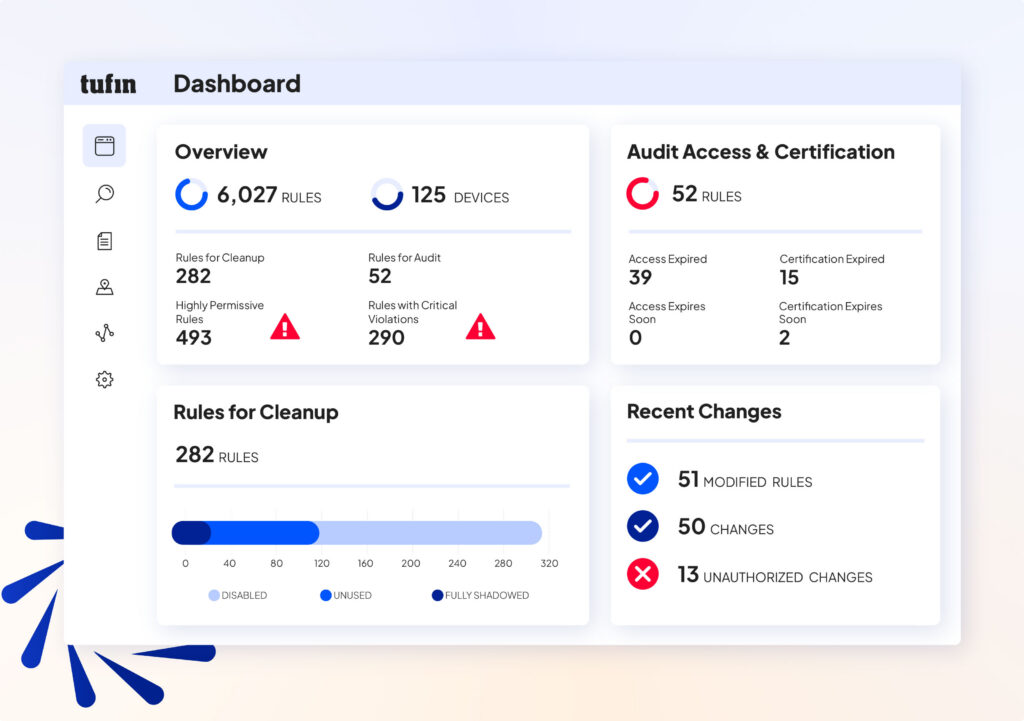
Microsegmentation in a Silo Leaves Critical Gaps Across the Enterprise
Akamai Guardicore Segmentation is a cloud-native microsegmentation platform built to address Zero Trust mandates. It enforces Zero Trust principles at the workload level, delivering fine-grained access control and lateral movement containment across hybrid infrastructure.
For organizations making microsegmentation a core pillar of their Zero Trust strategy, Akamai Guardicore provides the enforcement precision that complex environments require.
But in the broader network, security teams need more than workload-level enforcement. As security architectures become more distributed, visibility across enforcement layers becomes more limited, and the operational burden of managing them grows. Policies governing application access must coexist with firewall rules, cloud security controls, SASE policies, and compliance requirements like PCI DSS and HIPAA. When these domains are managed in isolation, inconsistencies emerge quietly and accumulate over time.
In the agentic era, this problem becomes even harder. Workloads are relabeled, moved, or reclassified more frequently. Tag-driven microsegmentation policies shift automatically, altering enforcement scope without any explicit rule change and often without anyone noticing. Overly permissive access can persist because teams lack cross-domain visibility to catch it. Troubleshooting across NGFWs, cloud controls, and microsegmentation platforms becomes manual and error-prone. And when auditors ask questions, security teams are left reconstructing policy history across multiple systems, work that is time-consuming and unsustainable at scale.
Security teams do not just need more visibility. They need a continuous way to understand what is actually reachable, where exposure exists, and whether network security posture still matches security intent.
Akamai and Tufin: A Partnership for Total Network Control
Akamai Guardicore has become a trusted solution for organizations implementing microsegmentation, giving security teams the visibility and control needed to manage application-level traffic and reduce the risk of lateral movement inside the environment.
Tufin extends that value across the broader enterprise. Built on a unified control plane, Tufin aggregates Guardicore segmentation policies and contextualizes them alongside firewalls, cloud security controls, and SASE enforcement points to provide an end-to-end view of how access is managed across the hybrid enterprise.
That means segmentation enforcement becomes visible and auditable within broader network security workflows, connecting what was previously a standalone control into a more complete, enterprise-wide security and compliance strategy.
Unlike point products that focus narrowly on aligning firewall policies with segmentation controls, the joint solution connects microsegmentation to the full security ecosystem. Security and compliance teams gain the ability to understand how segmentation policies align with enterprise standards, how changes affect overall posture, and where real exposure exists across the environment.
Through Tufin’s AI-powered unified control plane, security teams gain:
- Centralized visibility across Guardicore segmentation policies, firewalls, cloud security controls, and other enforcement points in a single operational view
- A matrix-based model built on Guardicore labels to define, visualize, and validate intended segmentation strategy against actual enforced policy
- AI-powered policy analysis to identify overly permissive rules, misconfigurations, and access paths that represent active exposure risk
- Continuous drift detection that surfaces misalignment before it introduces compliance or operational risk
- Structured change management that brings microsegmentation updates into the same governed lifecycle as firewall and cloud policy changes, including risk analysis and documented approval
- Audit-ready compliance reporting across enforcement layers, eliminating the need to manually reconstruct policy history when regulators ask
The result is faster service delivery with policy validation embedded into existing workflows, lower operational burden through less manual analysis and troubleshooting, and more consistent compliance across hybrid infrastructure without slowing innovation.
Scaling Zero Trust in the Agentic Era
Akamai Guardicore Segmentation brings precise, workload-level Zero Trust enforcement to hybrid environments. Tufin extends that enforcement with enterprise-wide visibility, continuous posture validation, and coordinated policy management across the full security stack.
Together, Tufin and Akamai help organizations move beyond siloed controls toward a more scalable, operationalized approach to Zero Trust, one built for the realities of modern hybrid networks and the speed of the agentic era.
As hybrid environments grow more complex and change accelerates, the ability to continuously see, validate, and manage policy across every enforcement layer becomes central to maintaining a credible security posture. Organizations that combine enforcement precision with enterprise-wide visibility, governed control, and continuous compliance are the ones that will scale Zero Trust with confidence.
Learn more about how Tufin and Akamai Guardicore work together.
Ready to Learn More
Get a Demo