

Security is the second-biggest cloud challenge organizations report, behind only cost. Hybrid cloud environments add layers to that challenge: on-premises firewalls, cloud, SASE and microsegmentation policies all need to hold at once, across public cloud and private cloud alike. When one layer drifts, attackers move through the gap at machine speed.
Here is what that looks like in practice. A bank runs workloads across an on-premises data center, a private cloud and two public cloud providers. A network engineer approves a firewall change on Tuesday. The same access request reaches a cloud provider’s security group on Thursday, approved by a different team using different criteria. Neither team can see what the other approved. That gap, not a single bad rule, is where hybrid cloud security best practices break down for most companies running distributed cloud infrastructure.
Consistent policy baseline
The most common source of hybrid cloud exposure is not a missing control. It is a control that exists on-premises but does not translate correctly to the cloud layer, or a cloud policy with no equivalent at the firewall. Each vendor uses different syntax, different logic and different enforcement points. Teams managing each in isolation, across sprawling IT infrastructure and multiple cloud service providers, create network security gaps by accident.
A consistent policy baseline means one authoritative definition of permitted traffic, applied to every enforcement point across your cloud environments without manual reinterpretation. You write the intent once. The platform translates it across vendors and deployment models. That is the starting point for hybrid cloud security best practices that actually hold. It matters most under compliance requirements like PCI DSS, where auditors look for policy enforced everywhere, not a snapshot from last quarter. Regulatory compliance depends on proof, not intent.
Tufin’s control plane sits above individual vendor consoles. It governs firewalls, cloud, routers and switches, SASE and microsegmentation through one operational layer, spanning public cloud and private cloud deployments alike. When your policy says “deny all traffic to production databases except from the application tier,” that rule holds whether the workload sits on on-premises infrastructure, in AWS or behind a cloud-native control. See how cloud network security best practices apply across the full stack.
Least-privilege access
Least privilege is well understood in identity and access management. It is far less consistently applied to network access, and security teams often inherit the gap without realizing it. Most hybrid environments grant broader network reach than any cloud workload requires, because no one has a clear picture of what connectivity exists versus what is actually needed.
You cannot enforce least-privilege access without visibility. NIST SP 800-207A defines Zero Trust Architecture principles that apply directly here: verify explicitly, use least-privilege access, assume breach. The network layer is where those principles hold or fail. Role-based access control narrows who can request a change; it does not by itself narrow what the network permits once the change is made.
Tufin’s Dynamic Network Connectivity Graph is the data layer that makes least-privilege network access actionable. The graph shows who can talk to whom, what paths are reachable and where exposure exists at any point in time. When you can see every permitted connection across your hybrid cloud, you can identify over-permissive access policies and remove them with confidence rather than leaving them in place out of fear of breaking something.
Continuous segmentation validation
Segmentation is not a project you complete. It is a state you maintain. Network changes, new cloud workloads and vendor updates all shift the actual network segmentation of your environment, often without anyone intending them to.
The risk is that your segmentation design says one thing and your live network does another. Manual audits catch this days or weeks after the drift occurred, and audit trails alone only show you where the process broke down after the fact. By then, the exposure has existed long enough to matter.
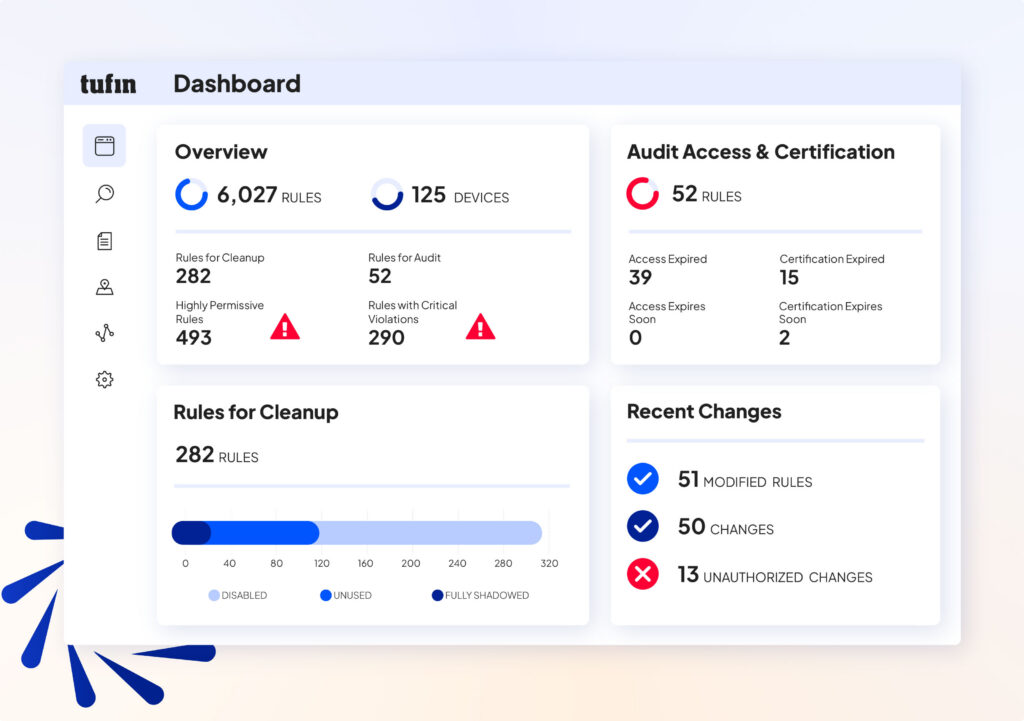
Tufin validates network segmentation continuously against your policy. When a change creates access that should not exist, the platform flags it immediately, supporting compliance and governance work that would otherwise depend on periodic manual review. You get continuous compliance rather than periodic snapshots. That is the difference between knowing your segmentation holds and hoping it does.
Governed change automation
Every network change is a potential exposure. Manual change processes slow down legitimate work and still miss risky changes, because human review does not scale to the volume or speed of modern hybrid cloud environments.
Governed change automation means changes go through a defined workflow: the request is checked against policy, risk is assessed automatically, compliant changes are pushed without delay and non-compliant changes are blocked before they reach production. You get speed without sacrificing control, and a clearer path to faster incident response when something does go wrong.
Tufin’s network playbooks codify that workflow. A developer requests access for a new application. The playbook checks whether that access violates any policy, identifies the affected enforcement points and either approves and implements the change automatically or routes it for human review based on risk level. The result is a full audit trail and faster delivery with fewer security incidents. One security team reduced manual review time and cut change-related risk after automating this workflow with Tufin.
Encryption and traffic visibility
Encrypting traffic in transit is a minimum requirement for hybrid cloud environments, and it addresses only part of the risk from data breaches. What gets overlooked is that encryption can create blind spots. When traffic is encrypted end-to-end using Transport Layer Security, controls that inspect payload content lose data visibility. The path still exists. The exposure from cyber threats and insider threats may still exist. You just cannot see it through content inspection alone.
Tufin’s connectivity graph operates at the path and policy level, not the payload level. It shows you which paths exist between workloads regardless of whether traffic is encrypted. You can confirm that a sensitive workload has no reachable path to an untrusted segment without depending on payload inspection. Path-level visibility and payload-level inspection address different risks. Data security and data protection require both, mapped together.
Tufin’s approach to hybrid cloud security
Tufin built its platform around one observation: the complexity of hybrid cloud environments is a data problem before it is a policy problem. You cannot write correct policy if you do not know what connectivity exists across on-premises resources and cloud infrastructure. You cannot detect drift without an authoritative baseline. You cannot automate change if you cannot predict its impact.
The Dynamic Network Connectivity Graph solves the data problem. It is the industry’s only continuously updated model of network connectivity across on-premises firewalls, cloud, routers and switches, SASE and microsegmentation. Every query about reachability, exposure or policy impact runs against that graph in real time, whether the environment includes a single cloud provider or multi-cloud environments spanning several. That is what continuous hybrid cloud monitoring for connectivity looks like: not a periodic scan, but a graph that is always current.
The control plane solves the operational problem: one layer to write policy, push changes, validate segmentation and support hybrid cloud monitoring for drift across every vendor and deployment model you run. Tufin’s agentic AI operates across the whole network using the graph as its foundation, not one product or one cloud in isolation. This is what a working hybrid cloud security architecture looks like: not a diagram, but a live model that matches your actual network.
The outcome is a hybrid cloud security posture that holds at machine speed rather than audit speed. You do not wait for a quarterly review to find out your segmentation drifted. You know immediately. You do not manually review every change request. Your playbooks handle the ones that are clearly compliant and surface the ones that need judgment. See hybrid cloud security in practice across multi-vendor environments.
If you currently manage hybrid security across disconnected tools, read how organizations unify cloud security under a single control plane.
Conclusion
Hybrid cloud security best practices only hold when the underlying data is accurate and the operational layer keeps pace with the rate of change. A consistent policy baseline, least-privilege access, continuous segmentation validation and governed change automation are achievable when a single platform maintains a live connectivity graph and applies one control plane across every vendor and deployment model in your environment. If you want to see how that works against your actual network, get a demo.
Frequently asked questions
What are hybrid cloud security best practices?
Hybrid cloud security best practices are the controls and operational disciplines that keep a network secure when workloads span on-premises infrastructure and one or more cloud environments. They include consistent policy across enforcement points, least-privilege access, continuous segmentation validation, governed change automation and encryption paired with path-level visibility. Each practice requires accurate, real-time knowledge of what connectivity exists across every layer of the environment.
What is different about securing a hybrid cloud versus a single cloud?
A single cloud environment gives you one provider’s console, one policy model and one set of native controls. A hybrid cloud adds on-premises infrastructure, and often more than one cloud provider, each with its own syntax and enforcement logic. Multi-cloud security addresses workloads spread across multiple public clouds. Hybrid cloud security spans that plus your own private infrastructure, including data centers and colocation. The practices are similar; the surface area to cover, and the number of teams whose work has to line up, is larger. Hybrid cloud computing multiplies coordination points that cloud computing confined to a single provider does not have.
For a closer look at where the two overlap and where they don’t, see the key distinction between hybrid and multi-cloud security.
What is the most important hybrid cloud security best practice?
Consistent policy is the foundation. Without a single authoritative policy that applies across on-premises and cloud, every other practice is harder to enforce: you cannot validate segmentation against a policy that does not exist, and you cannot automate change review if there is no clear policy to check against. Most organizations have policies written in multiple places with conflicting rules, which is where exposure originates.
See the top threats that inconsistent cloud security policy leaves organizations exposed to.
How do you maintain hybrid cloud security continuously?
Continuous hybrid cloud security requires a live model of your network that updates as changes occur, not a static diagram reviewed on a schedule. When your policy baseline, connectivity data and change management are connected, drift triggers an alert rather than appearing in an audit months later. Tufin’s control plane connects all three so your security posture reflects your actual network state at all times.
Ready to Learn More
Get a Demo