Outages and breaches keep making headlines, and in the first hours the cause is rarely clear. Some turn out to be attacks. Others trace back to a routine change, a cloud provider, a carrier, or failed hardware.
Whatever the cause, the question that lands on every security leader’s desk is the same: is my network at risk? The real fear isn’t just “we will be attacked.” It’s “we will be down, we won’t know why, and everyone will be looking at us.”
No tool can stop a cloud provider or a carrier from having a bad day. But the changes, access paths, and recovery choices inside your own network are yours to control, and the best time to get them right is before anything breaks. Here are seven ways to lower your risk and stay in control, whatever the cause of the next incident turns out to be.
1. Know who can actually reach what, not just who is supposed to.
Most security policies describe intent: which systems a vendor, a partner, or an employee should be able to reach. But intent and reality drift apart constantly as networks change. Attackers don’t care what your policy says. They care what is actually reachable. Reducing risk starts with an honest, current answer to a simple question: who can talk to whom across your network right now?
2. Treat third-party and partner access as its own risk category.
A growing share of recent breaches start with a trusted outsider, not a stranger: a partner’s login, a vendor’s integration, a contractor’s credential. Every external connection into your environment is a door, and doors need to be inventoried, time-limited, and closed the moment they are no longer needed. “We trust them” is not a control.
3. Assume something will go wrong, and plan for what happens next.
No prevention strategy is perfect, and pretending otherwise leads to brittle security. The more useful question is: once something breaks or someone gets inside, how far does the damage spread? One compromised account or device can snowball into broader access when nothing limits how far it can travel. Limiting how much of the network any single account, device, or change can reach, commonly called segmentation, turns a potential company-wide incident into a contained one.
Containment depends on understanding your segmentation before you need it. If you don’t know what’s connected, your only option is off. Teams that understand their segmentation can isolate the problem instead of the business.
4. Keep a current map of your network, not an outdated diagram.
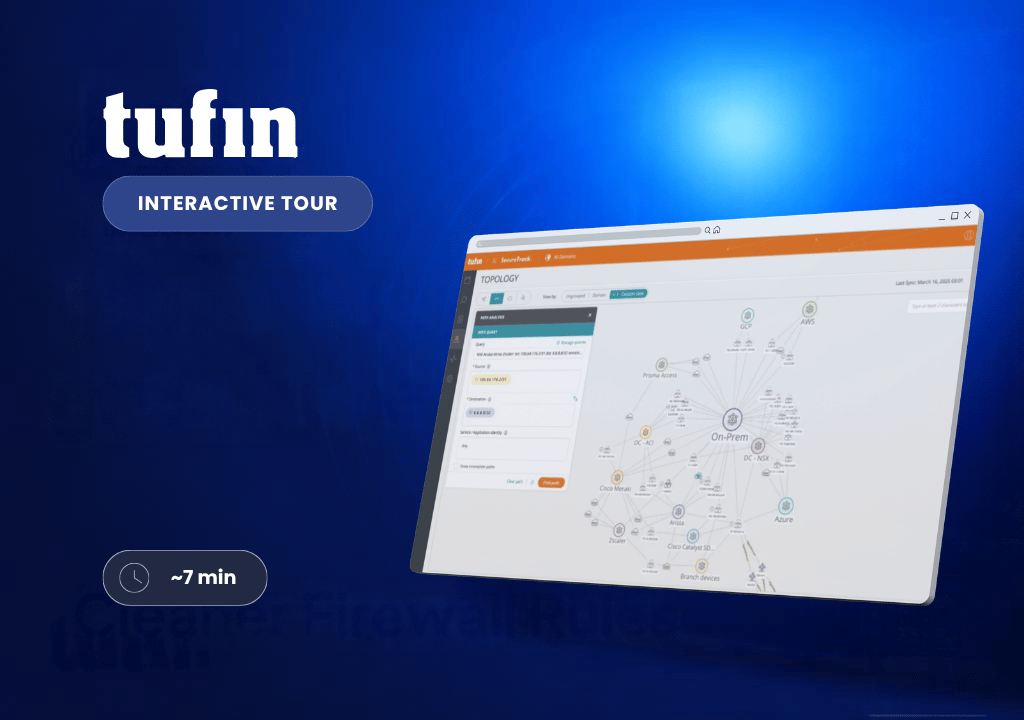
Enterprise networks change constantly: new cloud services, new vendors, new remote connections. A network diagram from last year’s audit is closer to historical fiction than a security control. Organizations that can see their real, current connectivity, across cloud, on-premises, and everything in between, catch exposure before attackers do.
That map matters when something does go wrong. It won’t tell you why an outage happened, but it helps narrow the search: what changed recently, what is connected, and what is safe to isolate. It is only as useful as it is current, so keep it up to date as the network changes rather than rebuilding it in the middle of an incident.
5. Pay special attention to the edges: VPNs, remote access, and internet-facing devices.
Threat intelligence this year consistently points to the same entry points: VPN infrastructure, remote access tools, and internet-facing edge devices. Exploiting a vulnerability is now the most common way attackers get in, ahead of stolen credentials.1 These are the digital equivalent of unlocked side doors, less visible than the front entrance, but just as real a way in. Regularly reviewing and tightening who and what can reach these systems closes off one of attackers’ favorite starting points.
That risk is speeding up. On Nov. 13, the FBI warned that attackers are using ARTEX, an open-source framework of autonomous AI agents, to automate intrusions from first scan to data theft, in some cases reaching privileged access in under three hours. The FBI’s first recommendation: inventory every internet-facing system, including the partner portals, legacy services, and forgotten apps these agents are especially good at finding.2
6. Before your next change, know what depends on it.
Most incidents start the same way: an ordinary change on an ordinary afternoon, made by someone just doing their job. So before your next change, do you know what depends on it? Which applications rely on that rule, which paths it opens or closes, and what else could break if it goes wrong? A point-in-time review can’t answer that, because networks change daily. Continuously checking what changed, who has access to what, and what each change touches makes ordinary days safer.
7. Make access removal as routine as access approval.
Access tends to accumulate. Employees change roles, vendors finish projects, temporary exceptions become permanent. Few organizations are disciplined about removing access once it is no longer needed, which means old, forgotten permissions quietly pile up as risk. Regularly recertifying who has access to what, and removing what nobody uses anymore, closes a gap attackers routinely exploit.
The common thread
Every one of these practices comes back to the same idea: you cannot protect what you cannot see, and you cannot control what you cannot account for. That is the whole point of network security posture management: a continuous, honest answer to the question everyone is asking right now, “Is my network at risk?”
“Right now, everyone is changing everything at once, and every one of those changes touches something. The teams that come through it are the ones that know what a change depends on before they make it, and can contain a problem without turning everything off. It’s going to be a bumpy stretch. Bumpy beats breached,” says Jeff Spear, CISO at Tufin.
This is the problem Tufin was built to solve. Tufin gives security teams a unified way to understand their real network connectivity, see what changed, continuously evaluate exposure, and control change safely across complex, multi-vendor environments. It is security that keeps the network running.
For leaders outside the security team, in sales, legal, or the executive suite, the takeaway is simpler. Ask your security organization two questions: before our next change, do we know what depends on it? And if something got in tomorrow, how far could it get? If the honest answer is “not easily,” that is the gap worth closing first.
Tufin provides the unified control plane for Multi-Vendor Agentic Network Security, giving organizations a trusted way to understand and control connectivity across the enterprise.
Works Cited
- Verizon. 2026 Data Breach Investigations Report. As reported by Kiteworks, “Vulnerability Exploitation Tops 2026 DBIR Initial Access,” 29 May 2026, www.kiteworks.com/cybersecurity-risk-management/vulnerability-exploitation-overtaking-credentials.
- Federal Bureau of Investigation. “Threat Overview of ARTEX Autonomous Penetration Testing Framework.” FBI FLASH-20261113-001, 13 Nov. 2026, www.ic3.gov/csa/2026/261113.pdf.
Ready to Learn More
Get a Demo