
AI Is Changing Network Security. Tufin Is Leading the Way.
Learn More


Global Energy Leader Unifies Multi-Vendor Security with Tufin
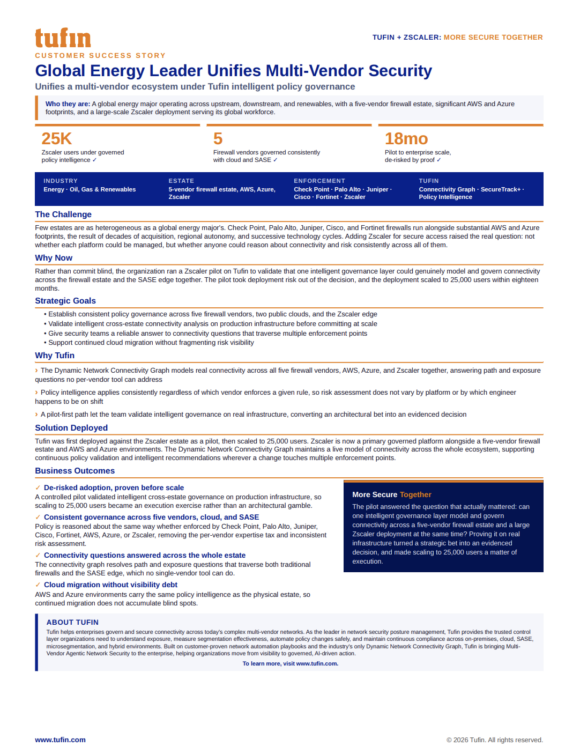
Download the case study to see how a global energy major brought five firewall vendors, AWS, Azure, and a 25,000-user Zscaler deployment under one intelligent governance layer — de-risked by a production pilot and scaled to enterprise in 18 months.
The Challenge: Reasoning About Risk Across One of the Industry’s Most Heterogeneous Estates
- Five Firewall Vendors and Two Clouds: Check Point, Palo Alto, Juniper, Cisco, and Fortinet firewalls running alongside substantial AWS and Azure footprints — the result of decades of acquisition, regional autonomy, and successive tech cycles.
- Zscaler Added Another Enforcement Layer: Adding Zscaler for secure access raised the real question: not whether each platform could be managed, but whether anyone could reason about connectivity and risk consistently across all of them.
- Architectural Bet Needed Proof: Committing at scale without validating that one governance layer could model the whole ecosystem was too risky — the team needed evidence on real infrastructure first.
The Results: One Governance Layer Across Five Vendors, Two Clouds, and SASE
- 25,000 Zscaler Users Under Governed Policy Intelligence: A controlled pilot validated cross-estate governance on production infrastructure, turning enterprise scale into an execution exercise rather than an architectural gamble.
- Consistent Governance Across Every Enforcement Point: Policy is reasoned about the same way whether enforced by Check Point, Palo Alto, Juniper, Cisco, Fortinet, AWS, Azure, or Zscaler — removing the per-vendor expertise tax and inconsistent risk assessment.
- Cloud Migration Without Visibility Debt: AWS and Azure environments carry the same policy intelligence as the physical estate, so continued migration doesn’t accumulate blind spots, and the connectivity graph resolves path questions that traverse both firewalls and the SASE edge.
Get Started with Tufin
Contact our experts to learn more about pricing, receive a free network and firewall risk assessment, or schedule a demo.