
AI Is Changing Network Security. Tufin Is Leading the Way.
Learn More


Aligning Your Security Policy with NIST 800-207 Zero Trust Principles
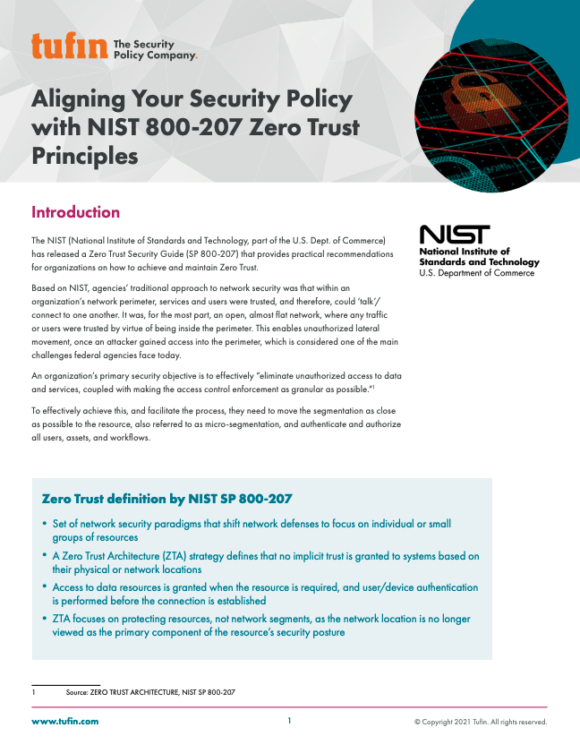
A practical guide to how Tufin’s segmentation policy management maps to NIST SP 800-207 Zero Trust principles across six key areas: visibility and topology, segmentation, policy optimization, change monitoring, risk assessment, and continuous compliance.
NIST SP 800-207 defines Zero Trust as a shift away from perimeter-based security toward resource-level protection, where no implicit trust is granted based on physical or network location, and access to data is only granted after authentication and authorization. For federal agencies and enterprises adopting Zero Trust, the harder question isn’t what the architecture is, but how to operationalize it across hybrid networks that span on-premises firewalls, multi-cloud, SDN, and application-level controls. Zero Trust at the architectural level is well documented. Zero Trust at the policy management level is where most organizations struggle.
Download the solution brief to see how Tufin’s segmentation policy management maps directly to NIST 800-207 principles across six key areas: complete visibility and accurate topology modeling, security segmentation (including microsegmentation and allow-list policies), policy optimization through change automation, monitoring and control of network changes, risk assessment with vulnerability correlation, and continuous compliance against PCI DSS, HIPAA, NIST, CIS, and other frameworks. The guide covers specific Tufin capabilities that enable each NIST 800-207 principle in practice.
Get Started with Tufin
Contact our experts to learn more about pricing, receive a free network and firewall risk assessment, or schedule a demo.